
How to Propagate Aloe Vera
Aloe Vera is one of the easiest houseplants to propagate. Here are three reliable methods — choose the one that fits your comfort level and available supplies.
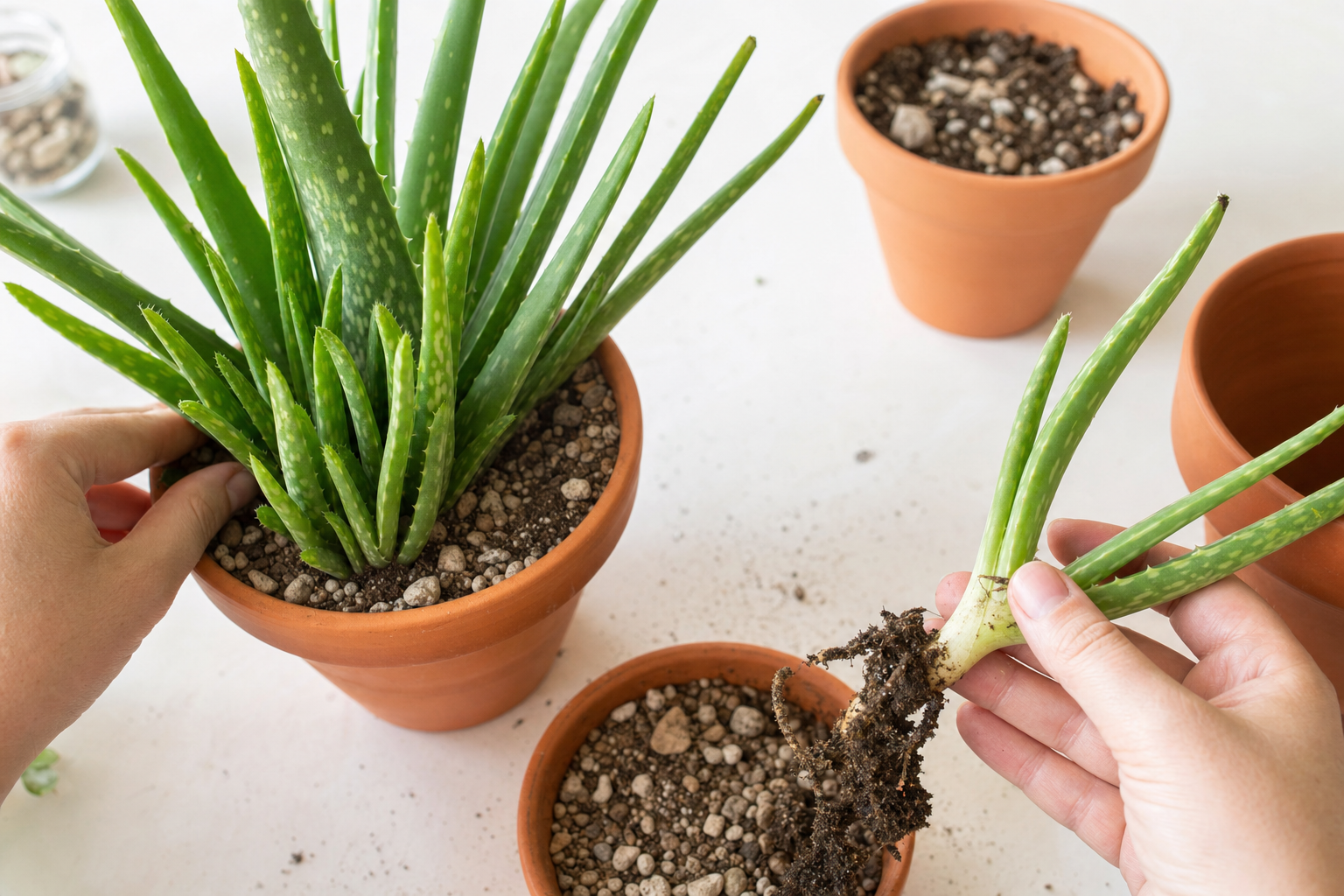
Pup separation (offset division)
This is by far the easiest and most reliable method, with the highest success rate of any aloe propagation technique. You will need a clean sharp knife or pruning shears, a small terracotta pot with drainage holes, cactus/succulent potting mix, and optionally rubbing alcohol for sterilizing your blade.
- 1 Wait until the pup is at least 3–4 inches tall and has several leaves of its own — separating too early reduces the pup's chances of survival because it lacks sufficient roots and stored energy.
- 2 The best time to separate pups is during spring or summer repotting when the root system is already exposed.
- 3 Remove the entire mother plant from its pot and gently shake off excess soil to expose the root structure.
- 4 Identify where the pup connects to the mother plant's root system.
- 5 Using your hands, carefully tease the pup away from the mother plant, trying to keep as many of the pup's roots intact as possible. If the pup is firmly attached to the mother's rhizome, use a clean, sharp knife to cut it away, including a portion of the connecting root.
- 6 Let the cut surface dry and callus for 1–2 days in a shaded, dry spot — this critical step prevents rot at the wound site.
- 7 Fill a small terracotta pot (1–2 inches wider than the pup's root ball) with dry cactus/succulent mix.
- 8 Plant the pup at the same depth it was growing at previously, and gently firm the soil around the roots.
- 9 Wait 3–5 days before watering to allow any cut roots to heal — watering too soon invites rot.
- 10 After the initial delay, water sparingly and keep the pup in bright indirect light, protected from direct sun for the first week.
Expected timeline: the pup continues growing with minimal setback, new roots establish in 2–3 weeks, new leaf growth visible within 4–6 weeks. Success rate: approximately 90–100% when the pup has its own roots.
Success rate: approximately 90–100% when the pup has its own roots.
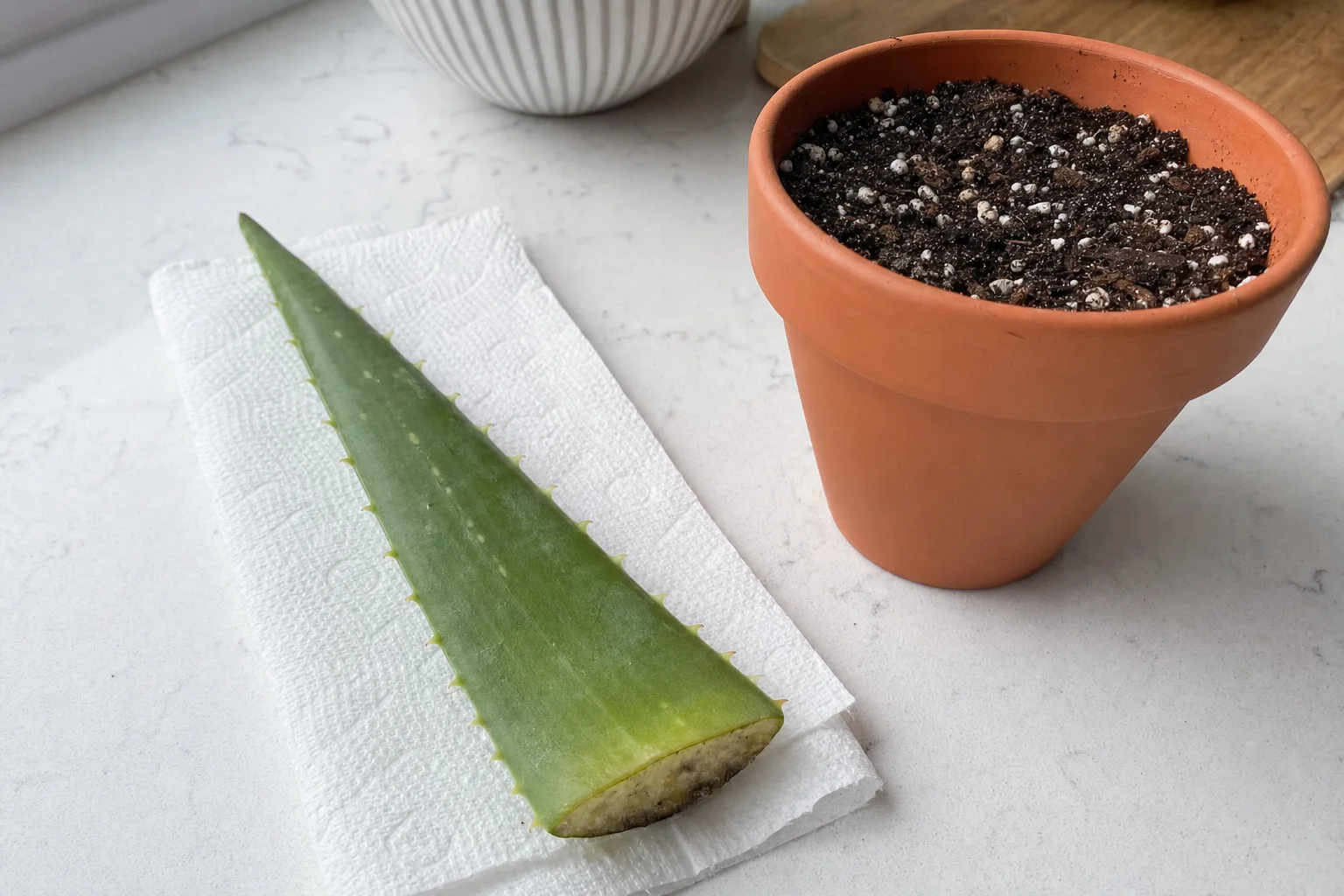
Leaf cuttings
While technically possible, leaf cuttings are far less reliable with aloe vera and are generally not recommended unless you have no access to pups. You will need a healthy mature leaf, a clean sharp knife, cactus/succulent potting mix, and a small pot with drainage.
- 1 Select a thick, healthy outer leaf from a mature plant — avoid young center leaves which the plant needs.
- 2 Cut the leaf cleanly near the base with a sterilized knife.
- 3 Let the cut end callus for 3–5 days in a dry, shaded location — do not skip this step, as uncallused leaf cuttings rot almost immediately in soil.
- 4 Fill a small pot with slightly moist (not wet) cactus mix.
- 5 Insert the callused cut end about 1 inch deep into the soil, and gently firm the soil around it.
- 6 Place in bright indirect light and do not water for the first 7–10 days.
- 7 After the initial dry period, water very sparingly — only when the soil is completely dry.
- 8 Be extremely patient; if the leaf is going to root, it may take 4–8 weeks to show any signs of new growth at the base. Many leaf cuttings simply shrivel and die without producing roots.
Expected timeline: callus forms in 3–5 days, rooting begins at 4–6 weeks (if successful), new pup emerges at 8–12 weeks. Success rate: approximately 20–30% — the leaf often rots before roots form, which is why pup separation is strongly preferred.
Success rate: approximately 20–30% — the leaf often rots before roots form, which is why pup separation is strongly preferred.
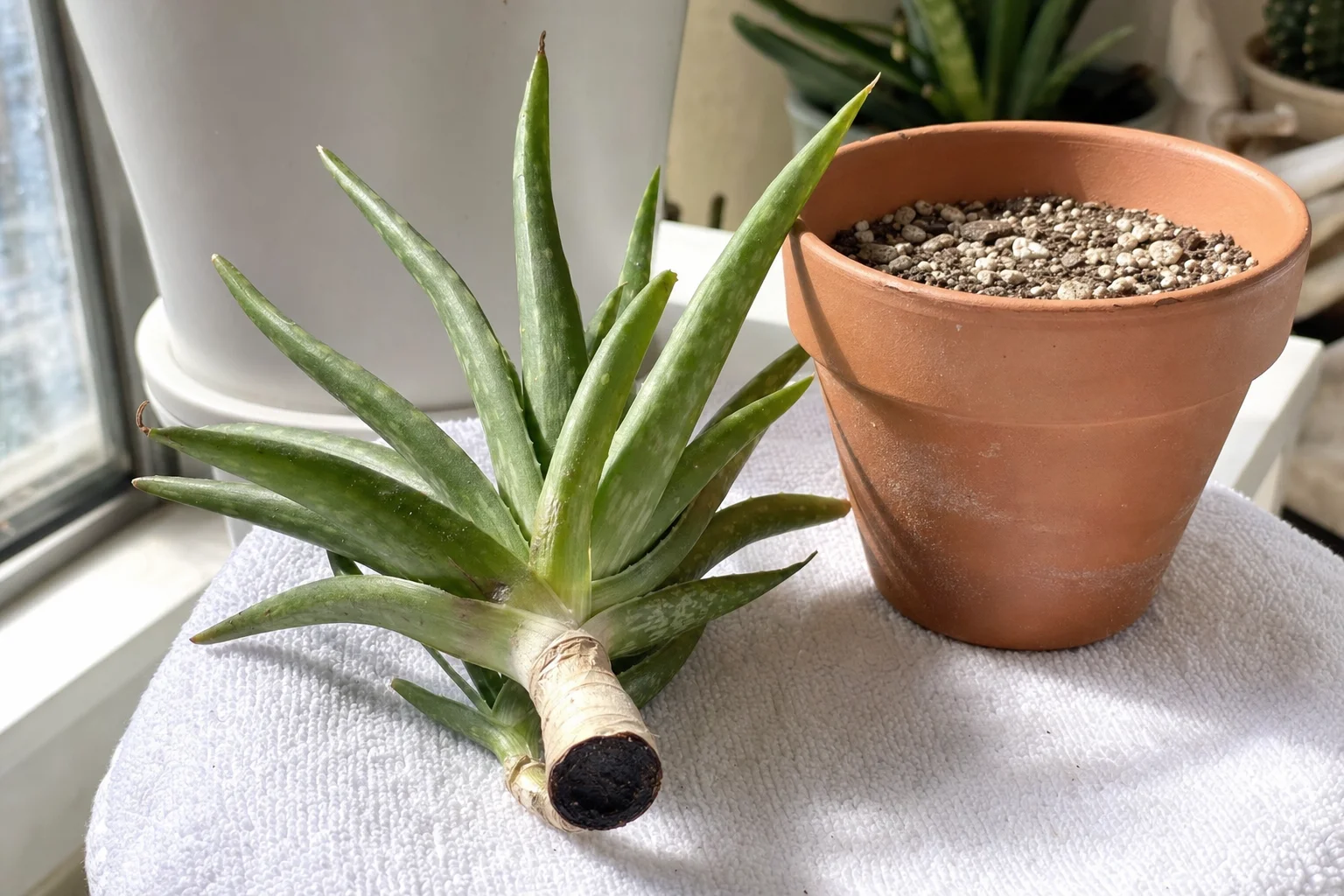
Stem cuttings (for leggy plants)
If your aloe has grown tall and leggy with a bare stem, you can behead it and reroot the rosette.
- 1 Cut the rosette off the top of the stem, leaving about 2 inches of stem attached.
- 2 Remove the lowest leaves to expose about 1 inch of bare stem.
- 3 Let the cut end callus for 3–5 days.
- 4 Plant the callused stem in dry cactus mix and wait 5–7 days before watering.
- 5 Keep in bright indirect light and water sparingly until new roots establish. The bare stem left in the original pot may also produce new pups from dormant growth points.
Expected timeline: roots in 3–4 weeks, new growth in 6–8 weeks. Success rate: approximately 70–80%.
Success rate: approximately 70–80%.
Troubleshooting Common Issues
Pup rotting after planting
If the base of a newly planted pup turns brown, mushy, or translucent, rot has set in — almost always from watering too soon after separation. Remove the pup from the soil, cut away all mushy tissue with a sterilized knife until you reach firm, healthy flesh, let it callus for 2–3 days, and replant in fresh dry cactus mix. Going forward, always wait 3–5 days after planting before watering, and use terracotta pots which help the soil dry out faster.
Pup not growing after several weeks
A newly separated pup may stall for 2–4 weeks as it directs energy toward root establishment rather than leaf growth. This is normal. Ensure the pup is in bright indirect light (not deep shade) and that you are not overwatering — new pups with small root systems need very little water. If the pup is firm and green, it is healthy and will resume growth once roots are established. A light application of diluted succulent fertilizer after 6–8 weeks can help kickstart growth.
Leaf cutting shriveled without rooting
This is the most common outcome with aloe leaf cuttings — the leaf simply dries up and shrivels because it cannot sustain itself long enough to produce roots. This is why pup separation is the recommended method. If you are determined to try leaf cuttings, increase your chances by using the thickest, plumpest outer leaf, allowing a full 5 days of callusing, and maintaining warm temperatures (75–80°F) with very sparse watering.
Pup has no roots
Pups separated too early or torn away roughly may come away with few or no roots. These can still be saved. Let the base callus for 2–3 days, then plant in dry cactus mix and wait 7–10 days before giving a small amount of water. The pup will grow new roots from the base, but expect slower initial growth. Placing the pot on a propagation heat mat at 75°F can accelerate root development. Avoid the temptation to overwater — roots will not form in soggy soil.
Propagation Tips
- ✓ Always use clean, sterilized tools to prevent infection
- ✓ Cuttings need bright indirect light — never direct sun
- ✓ Change propagation water every 5–7 days to prevent bacteria
- ✓ Be patient — rooting takes 2–6 weeks depending on the method
- ✓ Spring and summer are the best seasons for propagation